
If you have ever woken up in the middle of the night sweating through your sheets, you already know that temperature plays a huge role in how well you sleep. What most people do not realize is that their mattress is one of the biggest factors driving that experience. The materials inside your mattress, the way it is constructed, and how it interacts with your body heat can either work with your sleep or against it.
Why Does Body Temperature Matter So Much During Sleep?
Your body temperature naturally drops as you fall asleep, and that drop is not accidental. It is part of how your brain signals that it is time to rest.
Core body temperature begins declining about an hour or two before you feel sleepy. It continues falling through the early stages of sleep, reaching its lowest point in the early morning hours before gradually rising again as you approach waking. This cycle is tightly linked to your circadian rhythm, the internal clock that governs sleep and wakefulness.
When your sleep environment is too warm, your body struggles to complete that natural temperature drop. You spend more time in lighter sleep stages, wake up more frequently, and get less of the deep, restorative sleep your body needs. Research consistently shows that a slightly cool sleep environment, typically somewhere between 65 and 68 degrees Fahrenheit for most adults, supports better sleep quality than a warm one.
Your mattress sits directly beneath you for seven to nine hours a night. If it traps heat instead of releasing it, it works against that natural cooling process regardless of how cool your bedroom is.
How Do Different Mattress Materials Handle Heat?
Not all mattresses respond to body heat the same way. The materials used in construction make a significant difference in how much heat builds up overnight.
Traditional memory foam is the most well-known heat-retaining material in the mattress industry. Its dense, viscoelastic structure conforms closely to your body, which is what makes it so effective at pressure relief. But that same close contouring limits airflow around your body. Heat gets trapped between you and the foam, and the mattress absorbs and holds it throughout the night. If you have ever slept on an older memory foam mattress and woken up feeling overheated, this is why.
Manufacturers have addressed this over the years with several approaches. Gel-infused memory foam incorporates cooling gel particles or layers designed to absorb and dissipate heat. Open-cell foam uses a more porous structure that allows air to move more freely through the material. Copper-infused foam works similarly, with copper particles added for their heat-conducting properties. These options perform better than traditional memory foam, though results vary depending on the quality and quantity of the cooling material used.
Latex foam, whether natural or synthetic, runs significantly cooler than memory foam in most cases. Natural latex in particular has an inherently open-cell structure and is often processed with pinholes throughout the core to increase airflow. It also responds to pressure differently than memory foam, pushing back against your body rather than conforming around it, which means less surface contact and less heat buildup.
Innerspring and hybrid mattresses tend to sleep the coolest of all common mattress types. The coil layer at the core of these mattresses creates substantial open space for air to circulate freely. Hybrids combine that coil base with comfort layers of foam or latex on top, giving you the pressure relief of foam with the airflow advantages of a spring system.
What Is the Connection Between Mattress Firmness and Temperature?
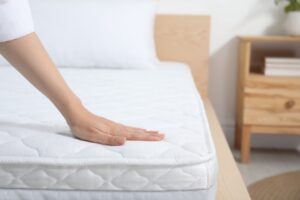
Firmness and temperature are more connected than most shoppers realize, and it comes down to surface contact.
A softer mattress allows your body to sink deeper into the material. More of your body surface is in contact with the mattress at any given time. More contact means more heat transfer between your body and the mattress, and more potential for that heat to build up over the course of the night.
A firmer mattress keeps your body closer to the surface. Less sinkage means less contact area, which generally translates to better airflow around your body and less heat retention. This does not mean a firm mattress is always the right choice, since firmness needs to be matched to your sleeping position and body type for proper spinal support. But if you run warm at night and you are deciding between two mattresses that both meet your support needs, the firmer option will typically sleep cooler.
Does Your Sleeping Position Affect How Hot You Sleep?
Yes, and it is worth factoring in when you are mattress shopping.
Side sleepers tend to experience the most heat-related discomfort because they sink deeper into the mattress at the shoulder and hip. This increases the contact area and reduces airflow around the torso. Side sleepers who run warm benefit most from a mattress that offers pressure relief without excessive sinkage, which is where latex and higher-quality gel memory foam tend to perform well.
Back sleepers distribute their weight more evenly across the mattress surface, which reduces sinkage depth and generally results in less heat buildup than side sleeping.
Stomach sleepers have the least contact area relative to body weight and tend to sleep the coolest of the three positions. The main concern for stomach sleepers is spinal alignment rather than temperature regulation.
If you and a partner share a mattress and one of you sleeps significantly warmer, look for mattresses with individually responsive comfort layers rather than a single uniform foam core. Zoned support systems and hybrid constructions handle mixed sleep preferences more effectively than solid foam mattresses.
What Other Factors Influence Sleep Temperature Beyond the Mattress?
The mattress is important, but it works within a larger system. Several other factors interact with it to determine your overall sleep temperature.
Your foundation or bed frame affects airflow beneath the mattress. A solid platform that seals off the underside reduces ventilation compared to a slatted base or a traditional box spring. If you sleep warm and your mattress sits on a solid surface, improving the base can make a meaningful difference.
Your bedding choices matter just as much as the mattress. Natural fiber sheets, particularly cotton percale and linen, breathe significantly better than synthetic microfiber. A mattress protector is important for hygiene and warranty protection, but a thick waterproof protector can trap heat. Look for protectors with breathable or moisture-wicking properties instead.
Pillow construction also plays a role. Dense foam pillows retain heat around the head and neck. Shredded latex, buckwheat, and down alternative fills with open structures tend to sleep cooler.
Finally, the room itself sets the baseline. No mattress will fully compensate for a bedroom that stays above 72 degrees through the night. Ceiling fans, programmable thermostats, and blackout curtains that block daytime heat gain all support the temperature-regulating work your mattress is doing.
How Do You Know If Your Current Mattress Is Contributing to Your Sleep Temperature Problems?
A few clear signs point to the mattress as the source rather than the room or your bedding.
If you sleep comfortably on the edge of the mattress but overheat when you move to the center, the mattress materials are almost certainly trapping heat. The edges of most mattresses have less foam depth, which means less heat retention.
If you wake up with night sweats even when the room is cool and your bedding is lightweight, the mattress is the most likely culprit. A cool room and breathable sheets should be enough to regulate temperature for most people. When they are not, the mattress is usually working against the system.
If your mattress is more than seven to eight years old, the foam has likely broken down enough that it is sleeping hotter than it did when new. Foam degradation reduces the effectiveness of any cooling technologies built into the original construction.
Frequently Asked Questions
What type of mattress is best if you sleep hot?
Hybrid mattresses with a coil core and a thin comfort layer tend to sleep the coolest because of the airflow the coil system provides. Latex mattresses are also a strong option. If you prefer an all-foam feel, look for open-cell or gel-infused foam with a cover material specifically designed for breathability rather than a standard quilted top.
Does a mattress topper make you sleep hotter?
It depends entirely on the material. A dense memory foam topper will add heat retention. A thin latex topper or a wool topper can actually help regulate temperature by wicking moisture and allowing more airflow. If your mattress is otherwise performing well but you need a little extra softness, choose a topper material carefully based on how you sleep temperature-wise.
Can two people with different temperature needs share one mattress?
Yes, though it requires some thought in the selection process. A hybrid with individually wrapped coils responds to each sleeper’s weight and position independently, which reduces motion transfer and allows each side to regulate differently. Some mattress brands offer split firmness options for couples. Pairing those with separate bedding on each side of the bed gives each person more control over their own sleep temperature.
How long does it take to adjust to a new mattress if you have been sleeping hot?
Most people notice a difference within the first few nights, though a full adjustment period can take two to four weeks as your body adapts to the new surface. If you are still sleeping significantly warmer than expected after a month, revisit your bedding and room temperature before concluding the mattress is the problem.
Is a cooling mattress cover worth it?
A quality cooling cover can make a noticeable difference, particularly if your current mattress is otherwise comfortable but retains too much heat. Phase-change material covers are the most effective at actively drawing heat away from the body. They cost more than standard covers but outperform basic moisture-wicking options for people who run consistently warm at night.
The Bottom Line
Temperature is one of the most underrated factors in sleep quality, and your mattress has more influence over it than most people realize. Understanding how different materials handle heat, how firmness affects surface contact, and how your sleeping position fits into the equation gives you a real advantage when shopping. The right mattress does not just support you physically. It works with your body’s natural sleep rhythms rather than against them.